
Ground your writing
in your research library

As you write, recall relevant passages, check your claims against the evidence, and keep going with instant, evidence-grounded autocomplete.

Ground your writing in your research library

Start free · No invitation required · macOS / Windows

What sets Flowing apart ↓Ideas or issues? Tell us in the forum

A next-generation academic writing workflow

Recall · Evidence · Writing with AI

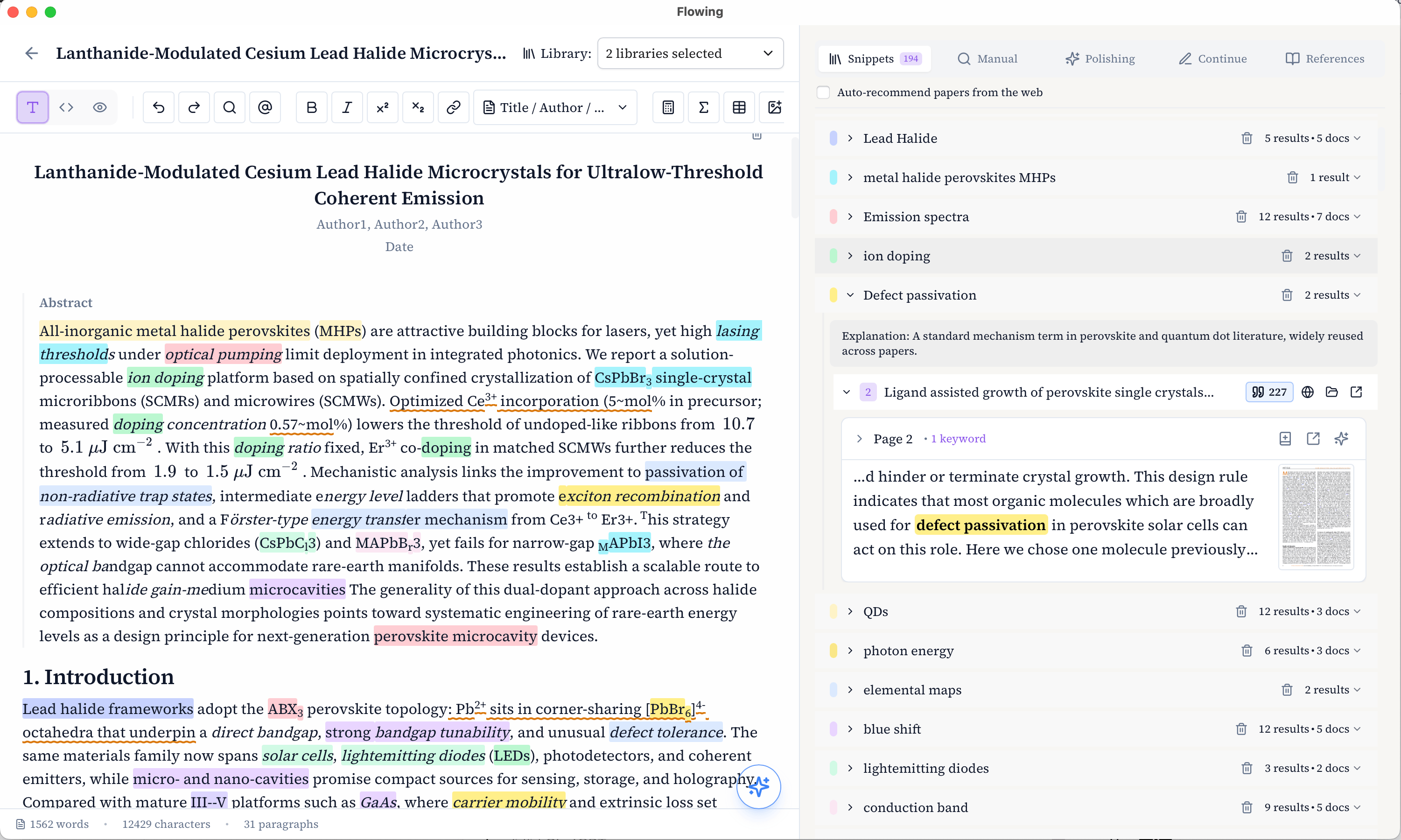
Flowing main workspace — write on the left with research snippets and references on the right

What sets Flowing apart

YOUR DRAFT

A passage worth keeping.

Selecting reaction conditions requires balancing conversion with the formation of the desired product. Published studies offer a starting point for identifying which experimental variables deserve closer examination.

Prior work suggests that influences the reaction pathway and ; catalyst loading may also shape selectivity.

↗ Select a highlighted phrase to recall related passages.
“temperature”2 passages · 2 papers

Comparisons between studies depend on the conditions behind each reported value. Catalyst loading, reaction time, and the temperature window must be considered before attributing a change in yield to a single factor.

The next experiments will vary temperature while keeping the remaining conditions fixed. Measuring both yield and product distribution will help distinguish improved conversion from a shift toward competing pathways.

RECALLED PASSAGES
PDF · p. 12
Temperature dependence

Increasing the temperature from 40 °C to 60 °C reduced the reaction yield from 68% to 42%, indicating less favorable product formation at the higher temperature.

PDF · p. 8
Tested temperature range

The effect was observed between 20 and 30 °C. Temperatures outside this range were not tested.

PDF · p. 24
Product selectivity

Product selectivity varied with reaction temperature. The highest isolated yield was obtained at 40 °C under the tested conditions.

PDF · p. 18
Yield optimization

Under otherwise identical conditions, optimized catalyst loading improved isolated product yield while preserving selectivity.

Snippet Card

01 / Snippet Card

Recall the passage, not just the paper

Find the passage behind your thought and jump back to its full source context.

YOUR DRAFT

Temperature and yield

Temperature is a key variable in the comparison of reaction conditions. The reported yields provide a basis for examining how thermal changes affect product formation within the experimental system.

At 60 °C, the reaction yield increased from 42% to 68%. This improvement suggests that higher temperature favors product formation.

Interpreting this comparison requires separating the reported result from its proposed explanation. Yield alone does not establish a mechanism; catalyst stability and competing reaction pathways also need to be considered.

Further experiments should examine these contributions individually, using matched reaction conditions to distinguish temperature effects from changes in catalyst activity or product selectivity.

EVIDENCE CHECK
× Contradicted

The numbers are reversed.

The source reports a decrease from 68% to 42% at 60 °C, not an increase. The draft reverses both the values and the direction of the effect.

RESEARCH ARTICLE · DEMOp. 12
3.2 Temperature-dependent yield

Increasing the temperature from 40 °C to 60 °C reduced the reaction yield from 68% to 42%, indicating less favorable product formation at the higher temperature.

Results are interpreted within the experimental conditions described here. The selected passage is highlighted for comparison with the manuscript.

Y = nproduct / ninitial × 100%(3)
68%42%4060T (°C)
Fig. 2 | Yield at two temperatures. Illustrative schematic.
Illustrative source excerpt · not a published paper

Evidence Card

02 / Evidence Card

Does the evidence support it?

Evidence Cards make it clear: red means conflict, green means support, and yellow means an important qualifier.

YOUR DRAFT

Keep the thought moving.

Temperature-dependent changes in reaction yield provide a useful starting point for selecting operating conditions. Applying these findings to a new system, however, requires attention to the range examined in the original experiments.

✦ WRITING WITH YOUR LIBRARY

Generating two sentences with linked source passages.

A follow-up study could extend the temperature series while holding catalyst loading and reaction time constant. Comparing yield and selectivity at each step would help establish whether the same trend persists.

LIBRARY EVIDENCE
Each passage links to its source · illustrative example

Autocomplete

03 / Autocomplete

Keep writing—with evidence

Watch the next sentence appear with its evidence, then inspect and accept it in place.

Ness Labs

Featured Tool

Recognized by Ness Labs

Featured in Tools for Thought

Ness Labs is a knowledge platform exploring the tools and ideas that help people think, learn, and work better. Flowing is now featured in its Tools for Thought series—alongside thoughtful productivity tools including Notion and Obsidian.

Read the interview on Ness Labs

How it works

From library to draft in seven steps

Import references, draft with rich text and LaTeX, autocomplete with evidence, recall passages, ask with context, polish, and continue writing—grounded in your local library.

Watch step-by-step tutorials

Research workflow

Fits into your existing research workflow

Flowing is a writing environment, not a reference manager. Import the PDFs you need for the section you are drafting; keep your canonical library where it already lives.

PDFs and index stay local · No full-library upload · AI requests send needed manuscript context and relevant passages Data flow

  • PDF

    Local import, search, preview, and export.

  • LaTeX

    Edit .tex beside rich text, with live PDF preview.

  • BibTeX

    Parses BibTeX and numbered bibliography blocks already in your draft.

  • Zotero

    Complementary—not a replacement. Keep Zotero for the canonical library.

  • Rich text

    Word-style editing in the app. Import and export manuscripts as Word (.docx) or PDF.

  • Citations

    Insert structured library citations with @, plus a References sidebar.

Keep using Zotero for your reference library, and Overleaf or Word where they already fit your workflow. Flowing focuses on the writing stage—bringing your papers, citations, and draft context together while you write.

How Flowing relates to Zotero

Direct Overleaf sync is not currently supported.

From the blog

Ideas behind Flowing

The idea of grounding AI-assisted academic writing in researchers' own knowledge and literature is gaining interest among researchers and academic professionals. Join the Substack to follow the conversation.

Start writing

Turn references into a real tool for polishing your paper.

Recall a passage, check a claim, and preview what comes next. Start with the paragraph already on your mind.