
Beyond ChatGPT: What the Next Generation of AI-Assisted Research Writing Could Look Like
This is a guest post by Hao Chou, a researcher working at the intersection of materials chemistry and optoelectronics.
Lately, I’ve been revising a manuscript on rare-earth-doped perovskite micro/nano lasers.
A friend of mine has been building a desktop academic writing tool called Flowing and asked if I’d be willing to test its continuation feature. Since I already keep ChatGPT open whenever I’m writing papers, I decided to compare them side by side.
The setup was simple: I placed both tools at the same point in the manuscript, gave them the same instruction, and evaluated only their first response.
This was not a controlled model benchmark. It was a comparison of the two tools as I would realistically use them in my everyday writing workflow.
After trying this across four different writing scenarios, I gradually realized that the interesting part wasn’t which continuation sounded more polished. It was which one was more likely to generate the sentence that actually belonged in my manuscript.
Here’s what I found.
Cursor 1 — A literature review needs continuity, not a premature summary
The first comparison came from a literature review paragraph. The paragraph had already begun discussing representative approaches for reducing lasing thresholds, and several more studies were about to follow.
At this cursor, I wasn’t looking for another overview of the field. I simply needed a sentence that could connect naturally to the remaining literature.
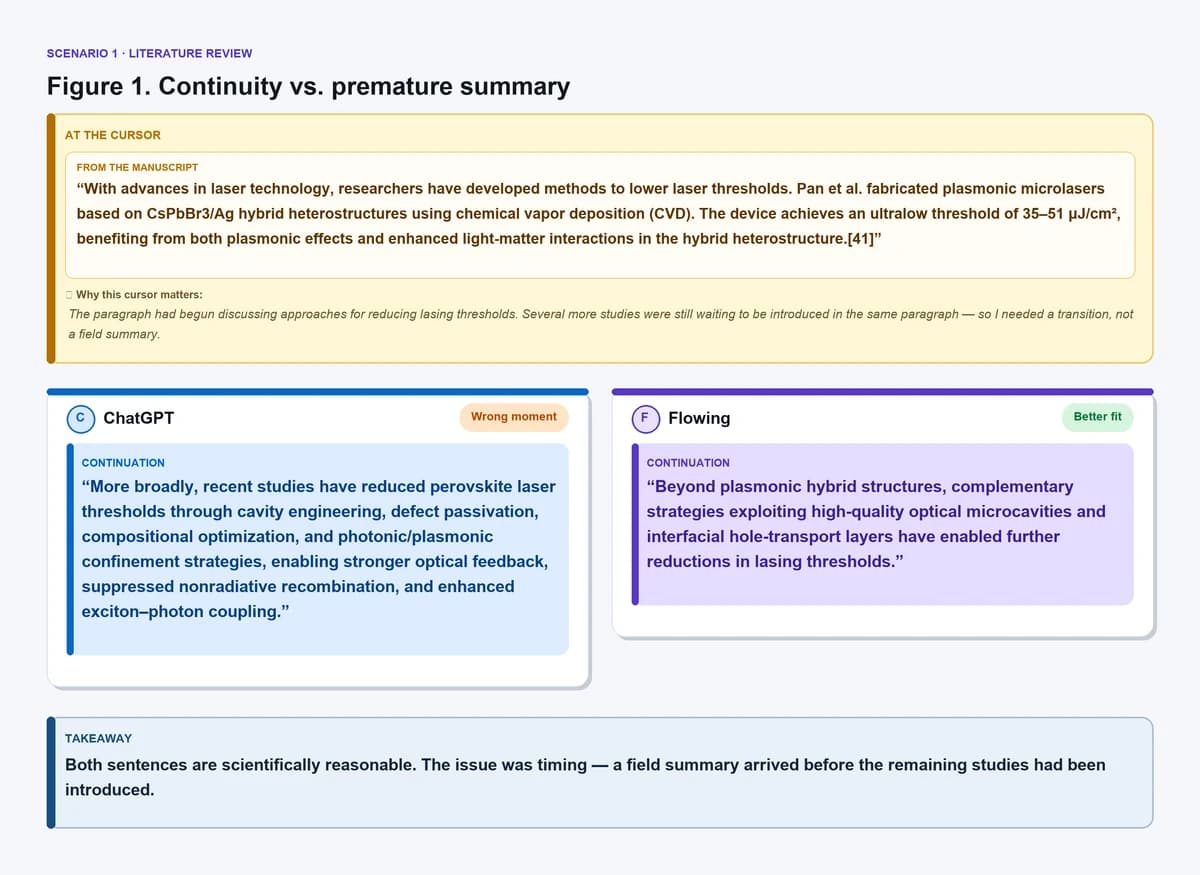
Flowing stayed within the local narrative of the paragraph and smoothly transitioned toward the following studies.
ChatGPT generated a broader summary covering cavity engineering, defect passivation, compositional optimization, and several other directions.
Taken by itself, I actually liked the sentence. The problem wasn’t correctness. It simply arrived too early: the remaining studies hadn’t been introduced yet, so summarizing the field at this point interrupted the rhythm of the literature review.
One thing that stood out to me was Flowing’s Evidence Card. Nearly every retrieved paper revolved around the same local topic, which may have helped the continuation stay aligned with the paragraph rather than drift toward a broader overview.
In the end, I kept Flowing’s continuation almost unchanged, while moving ChatGPT’s sentence to the end of the section, where it worked well as an overall summary.
Cursor 2 — A mechanism section should extend the reasoning, not restate the conclusion
The second comparison came from the mechanism discussion. The previous paragraph had already introduced the energy-level diagram. The next sentence wasn’t supposed to repeat that Ce³⁺ reduces the lasing threshold—it was supposed to explain why.
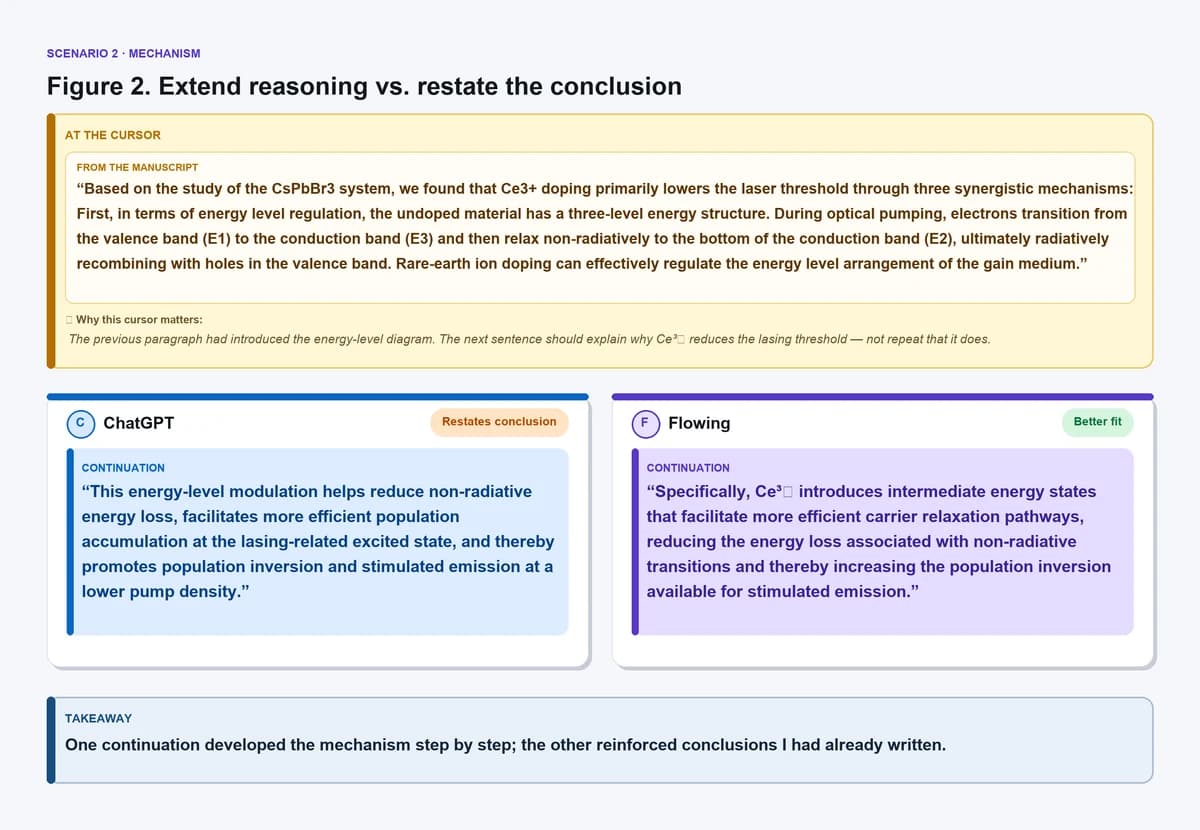
Flowing continued from intermediate energy states to carrier relaxation and eventually population inversion, extending the mechanistic reasoning step by step.
ChatGPT focused more on reinforcing conclusions that had already appeared, such as reduced non-radiative loss, improved carrier accumulation, and lower thresholds.
Both continuations were perfectly reasonable. The difference was simply their emphasis: one developed the mechanism further, the other reinforced what had already been established.
Cursor 3 — After characterization: bridge to function, not a field overview
The third comparison came after I had summarized SEM, EDS, and XPS results showing regular geometry, smooth surfaces, and high crystal quality. The paragraph was about to explain why that mattered for laser microcavities.
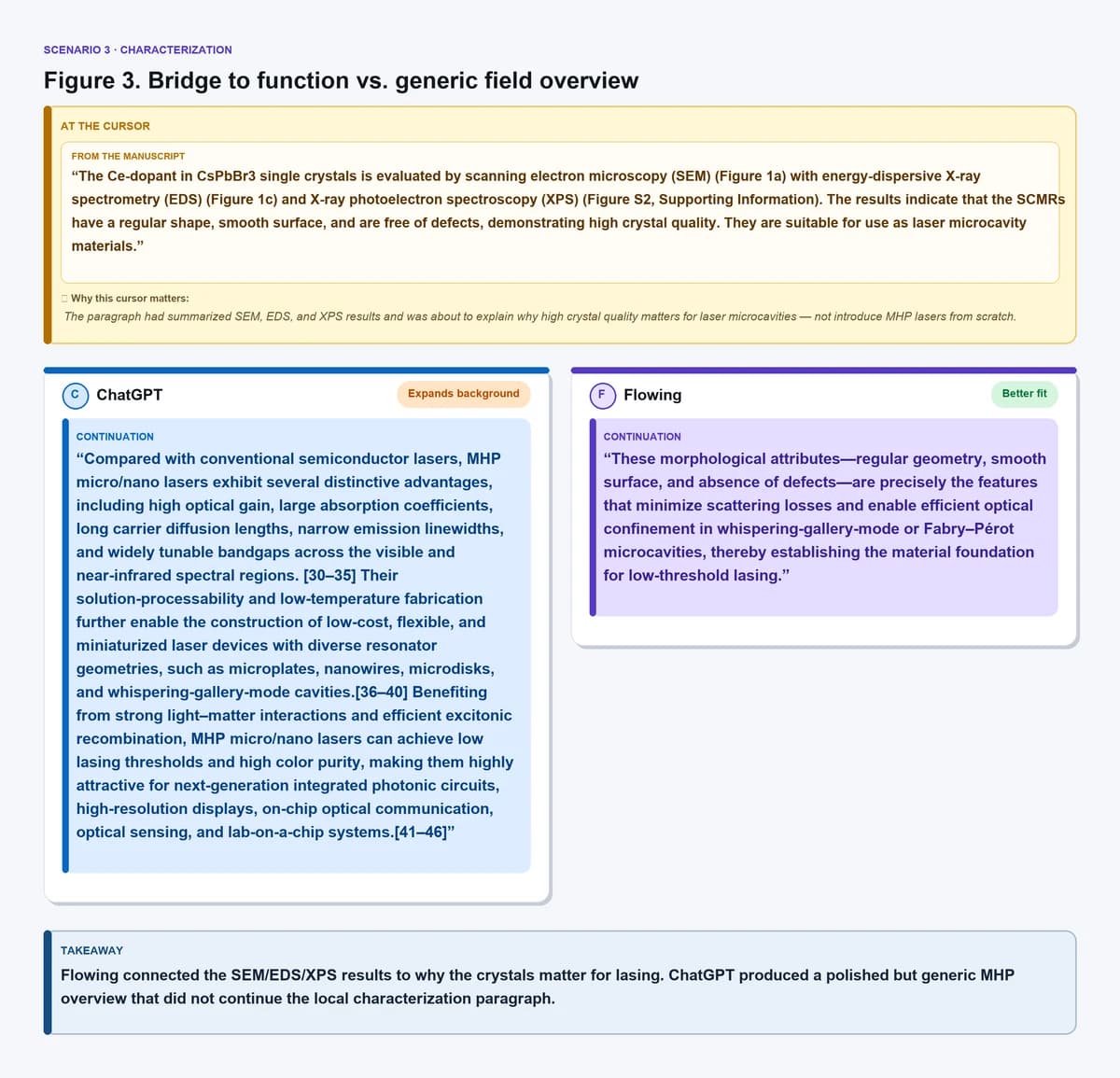
Flowing connected those morphological attributes to scattering losses, optical confinement, and Fabry–Pérot microcavities—almost writing the bridge into the next paragraph for me.
ChatGPT produced an excellent overview of MHP micro/nano laser advantages, applications, and citations. If the goal had simply been to introduce the field, I might even have preferred it. But at that cursor, I needed the paragraph to continue from the characterization results in front of me, not expand the background.
Looking back, I suspect this was also influenced by how the two systems used context. Flowing combines the current paragraph with evidence retrieved from related papers. Here, the retrieved passages stayed closer to crystal quality and optical confinement rather than pulling the discussion toward a generic field introduction.
Cursor 4 — Sometimes, the manuscript itself is the context that matters most
The last comparison changed my perspective the most. This paragraph had already confirmed laser oscillation.
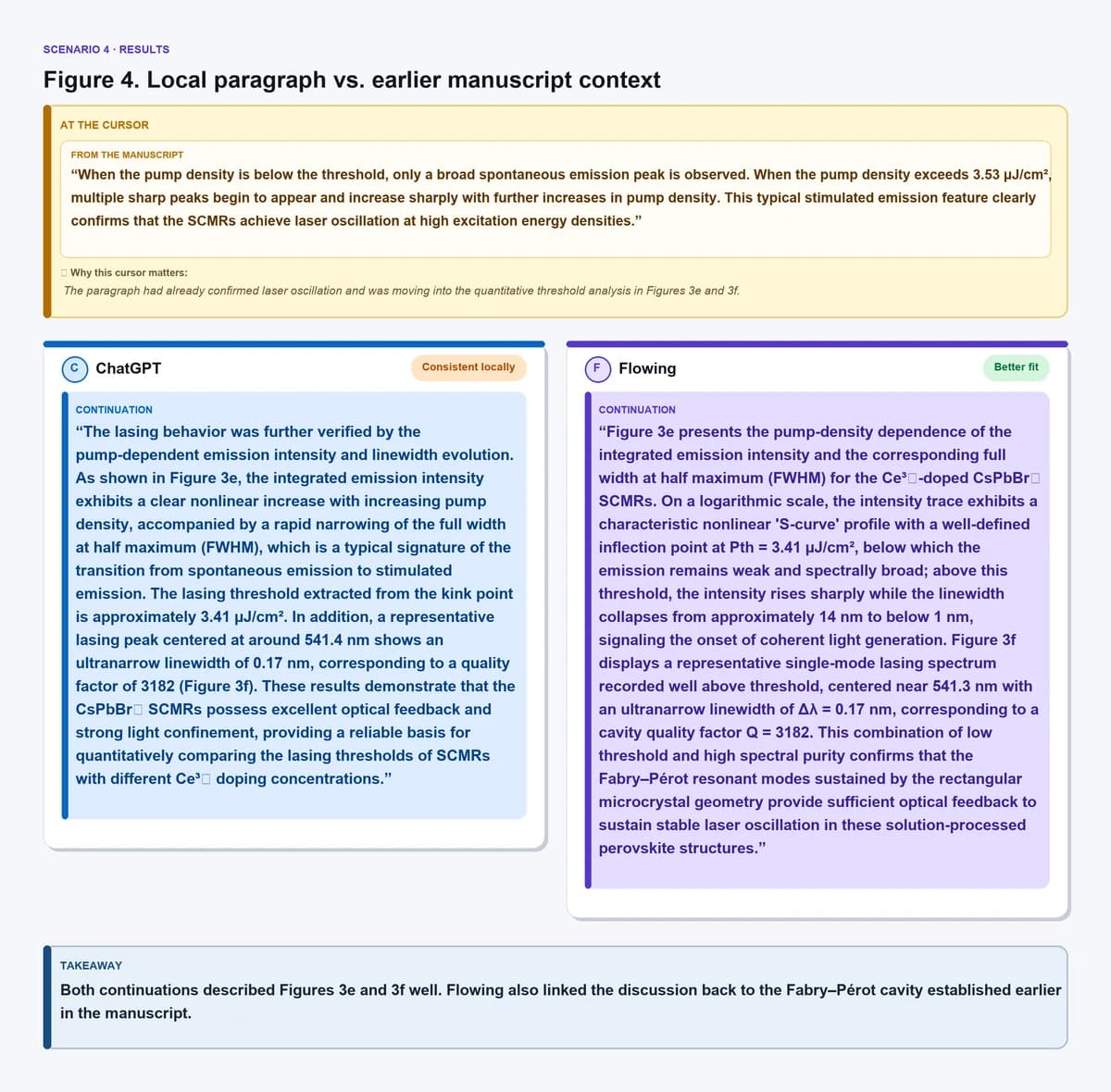
ChatGPT continued by discussing threshold behavior, linewidth narrowing, cavity Q factor, optical feedback, and light confinement. Everything was consistent with the local paragraph.
Flowing went one step further. It explicitly connected the discussion back to the Fabry–Pérot cavity that had already been established earlier in my manuscript, and linked it with the threshold analysis and cavity Q factor discussed in the following figures.
My first reaction was that this seemed slightly bold—the current paragraph never mentioned the Fabry–Pérot cavity. Then I remembered that I had already established it several pages earlier while discussing Figure 3c.
Flowing wasn’t inventing a new conclusion. It was reusing information that already existed in my manuscript because it dynamically incorporated context from the surrounding manuscript when generating the continuation. In my usual browser-based ChatGPT workflow, I would not realistically copy Figure 3c, its caption, and the surrounding discussion into every prompt.
That was the moment I realized something: for scientific continuation, the most valuable context isn’t always another fifty reference papers. Very often, it’s simply the manuscript you’ve already written.
Final thoughts
I still use ChatGPT every day—for brainstorming, exploring unfamiliar concepts, and improving wording. It remains one of the strongest general-purpose AI tools I use.
But once a manuscript is already taking shape and I need to continue from a specific sentence, Flowing is now the tool I tend to try first.
From my perspective, that is what makes Flowing different. It is designed to keep AI grounded in both your local literature library and the manuscript you are actively writing. In these four examples, that context often made the difference between a continuation that merely sounded good and one that actually fit.
Substack
Exploring the next generation of writing tools
Follow our Substack for essays on evidence-grounded AI writing, local research libraries, and where academic tools go next. Subscribe to join the conversation.
Join on Substack