
Ancla tu escritura
en tu biblioteca de investigación

Saca los fragmentos adecuados de tu biblioteca de investigación, escribe con IA y mantén cada borrador anclado en evidencia.

Ancla tu escritura en tu biblioteca de investigación

Empieza gratis · Sin invitación · macOS / Windows

Lo que distingue a Flowing ↓¿Ideas o problemas? Cuéntanoslo en el foro

El flujo de trabajo de escritura académica de nueva generación

Recall · Evidencia · Escritura con IA

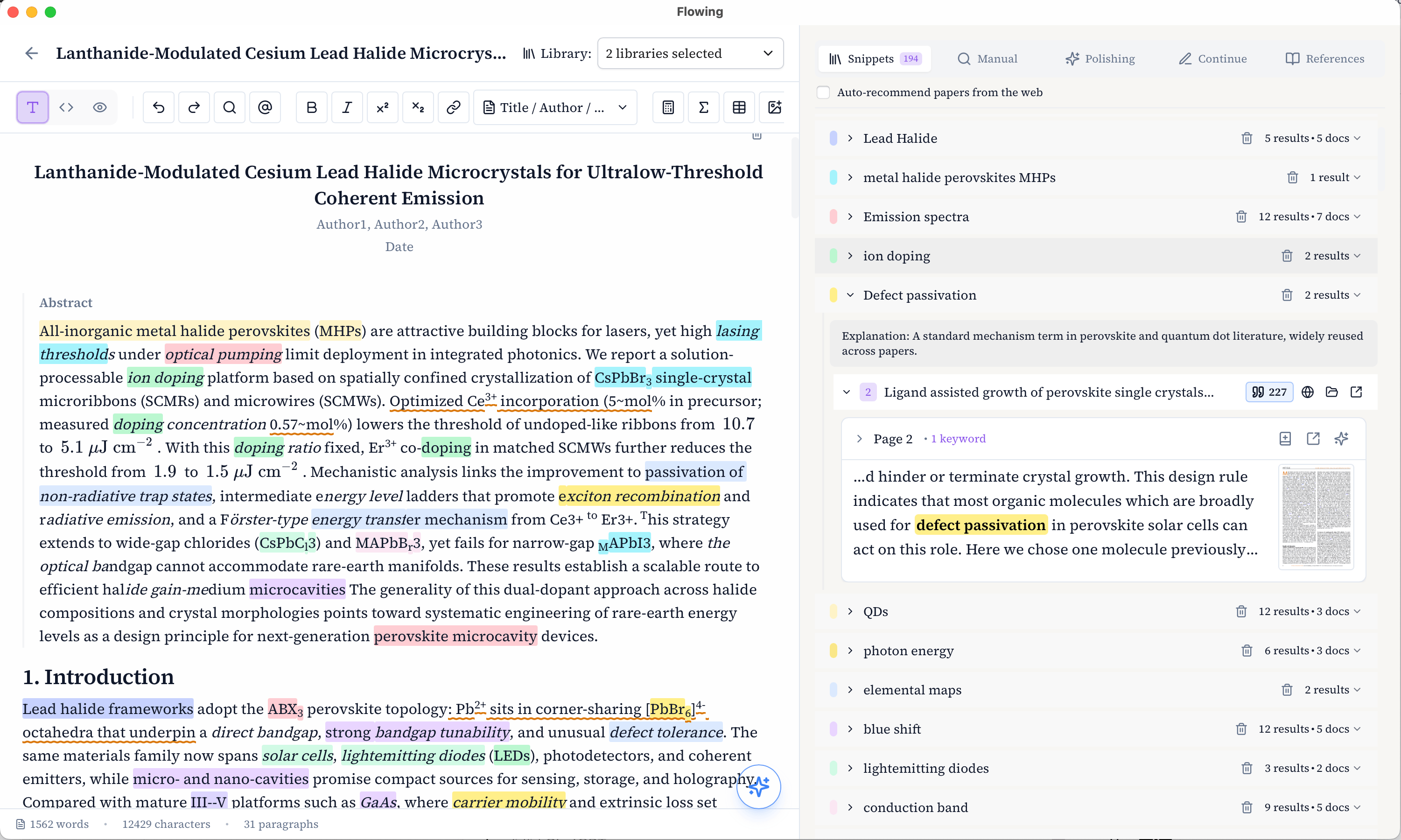
Espacio principal de Flowing: escribir a la izquierda, fragmentos y referencias a la derecha

Lo que distingue a Flowing

YOUR DRAFT

A passage worth keeping.

Selecting reaction conditions requires balancing conversion with the formation of the desired product. Published studies offer a starting point for identifying which experimental variables deserve closer examination.

Prior work suggests that influences the reaction pathway and ; catalyst loading may also shape selectivity.

↗ Select a highlighted phrase to recall related passages.
“temperature”2 passages · 2 papers

Comparisons between studies depend on the conditions behind each reported value. Catalyst loading, reaction time, and the temperature window must be considered before attributing a change in yield to a single factor.

The next experiments will vary temperature while keeping the remaining conditions fixed. Measuring both yield and product distribution will help distinguish improved conversion from a shift toward competing pathways.

RECALLED PASSAGES
PDF · p. 12
Temperature dependence

Increasing the temperature from 40 °C to 60 °C reduced the reaction yield from 68% to 42%, indicating less favorable product formation at the higher temperature.

PDF · p. 8
Tested temperature range

The effect was observed between 20 and 30 °C. Temperatures outside this range were not tested.

PDF · p. 24
Product selectivity

Product selectivity varied with reaction temperature. The highest isolated yield was obtained at 40 °C under the tested conditions.

PDF · p. 18
Yield optimization

Under otherwise identical conditions, optimized catalyst loading improved isolated product yield while preserving selectivity.

Snippet Card

01 / Snippet Card

Recuerda el pasaje, no solo el artículo

Mientras escribes, Flowing encuentra los pasajes que coinciden con tus palabras, los resalta en la página original y mantiene todo su contexto a un clic.

YOUR DRAFT

Temperature and yield

Temperature is a key variable in the comparison of reaction conditions. The reported yields provide a basis for examining how thermal changes affect product formation within the experimental system.

At 60 °C, the reaction yield increased from 42% to 68%. This improvement suggests that higher temperature favors product formation.

Interpreting this comparison requires separating the reported result from its proposed explanation. Yield alone does not establish a mechanism; catalyst stability and competing reaction pathways also need to be considered.

Further experiments should examine these contributions individually, using matched reaction conditions to distinguish temperature effects from changes in catalyst activity or product selectivity.

EVIDENCE CHECK
× Contradicted

The numbers are reversed.

The source reports a decrease from 68% to 42% at 60 °C, not an increase. The draft reverses both the values and the direction of the effect.

RESEARCH ARTICLE · DEMOp. 12
3.2 Temperature-dependent yield

Increasing the temperature from 40 °C to 60 °C reduced the reaction yield from 68% to 42%, indicating less favorable product formation at the higher temperature.

Results are interpreted within the experimental conditions described here. The selected passage is highlighted for comparison with the manuscript.

Y = nproduct / ninitial × 100%(3)
68%42%4060T (°C)
Fig. 2 | Yield at two temperatures. Illustrative schematic.
Illustrative source excerpt · not a published paper

Evidence Card

02 / Evidence Card

¿La fuente respalda esta afirmación?

Compara cada afirmación con los pasajes que la sustentan: rojo para contradicciones, verde para apoyo directo y amarillo para un matiz importante, siempre con acceso a la fuente exacta.

YOUR DRAFT

Keep the thought moving.

Temperature-dependent changes in reaction yield provide a useful starting point for selecting operating conditions. Applying these findings to a new system, however, requires attention to the range examined in the original experiments.

✦ WRITING WITH YOUR LIBRARY

Generating two sentences with linked source passages.

A follow-up study could extend the temperature series while holding catalyst loading and reaction time constant. Comparing yield and selectivity at each step would help establish whether the same trend persists.

LIBRARY EVIDENCE
Each passage links to its source · illustrative example

Autocomplete

03 / Autocomplete

Continúa la idea con la evidencia al lado

Flowing continúa el razonamiento en contexto y trae consigo los pasajes de respaldo. Observa cómo aparece el texto, revisa la evidencia junto a cada afirmación y acepta la continuación sin interrumpir tu flujo.

Ness Labs

Featured Tool

Reconocido por Ness Labs

Destacado en Tools for Thought

Ness Labs es una plataforma de conocimiento que explora herramientas e ideas para pensar, aprender y trabajar mejor. Flowing forma parte de su serie Tools for Thought, junto con herramientas como Notion y Obsidian.

Leer la entrevista en Ness Labs

How it works

From library to draft en siete pasos

Importa referencias, redacta con texto enriquecido y LaTeX, autocompleta con evidencia, recupera pasajes, pregunta con contexto, pule y continúa escribiendo—anclado a tu biblioteca local.

Watch step-by-step tutorials

Flujo de investigación

Encaja en tu flujo de investigación actual

Flowing es un entorno de escritura, no un gestor de referencias. Importa los PDF de la sección que estás redactando; deja la biblioteca canónica donde ya está.

Los PDF y el índice permanecen en este equipo · No se sube la biblioteca completa · Solo se envía el contexto seleccionado al usar IA Flujo de datos

  • PDF

    Importación local, búsqueda, vista previa y exportación.

  • LaTeX

    Edita .tex junto al texto enriquecido, con vista previa PDF en vivo.

  • BibTeX

    Analiza bloques BibTeX y bibliografías numeradas ya presentes en el borrador.

  • Zotero

    Complementario, no un reemplazo. Conserva Zotero para la biblioteca canónica.

  • Texto enriquecido

    Edición al estilo Word en la app. Importa y exporta manuscritos como Word (.docx) o PDF.

  • Citas

    Inserta citas estructuradas de la biblioteca con @, más una barra de References.

Sigue usando Zotero para tu biblioteca de referencias, y Overleaf o Word donde ya encajan en tu flujo. Flowing se centra en la etapa de escritura: junta tus artículos, citas y el contexto del borrador mientras escribes.

Cómo se relaciona Flowing con Zotero

La sincronización directa con Overleaf no está disponible por ahora.

From the blog

Ideas behind Flowing

La idea de basar la escritura académica asistida por IA en el conocimiento y la literatura propios de cada investigador está despertando un interés creciente entre investigadores y profesionales del ámbito académico. Únete al Substack para seguir la conversación.

Empieza a escribir

Convierte las referencias en una herramienta real para pulir tu artículo.

Retrieve by keyword, ask with full context, basis-backed polish from your library.