
The Missing Piece in AI Academic Writing Isn't the Model. It's Your Local Research Library.
Thinking about a brand new approach to evidence-grounded AI writing.
GPT-5. Claude. Gemini. DeepSeek. Every few months there’s another benchmark. Another leaderboard. Another “best writing AI.”
But after spending the last two years building tools for researchers, I became convinced that this wasn’t the real question.
The real question is: What should AI write from?
Researchers rarely start from an empty page
When researchers write papers, they rarely start from an empty page.
They constantly move between ideas they’ve already collected: a paragraph from a review paper, an experimental setup they bookmarked months ago, a sentence they highlighted last semester, an image buried somewhere in a PDF.
Those fragments are where writing actually happens.
But most AI writing tools aren’t built around that moment. Their default interaction starts from a blank prompt—so the researcher’s own library never enters the loop unless someone pastes it in by hand.
Today’s workflow leaves the library outside the loop
Today’s workflow usually looks like this: Prompt → LLM → Generated paragraph.
The model knows everything. Except the papers that actually matter.
Researchers end up copying paragraphs from PDFs into ChatGPT over and over again. Not because they enjoy it. Because the interaction gives the AI no lasting access to their paper library.
The overlooked problem isn’t writing. It’s retrieval.
Or more precisely—continuous retrieval while writing.
When writing a manuscript, you rarely know exactly which paper you need. Often you only remember: “I saw something similar a few months ago...” or “There was a really good explanation somewhere...”
The problem isn’t that the paper doesn’t exist. It’s buried somewhere inside hundreds or even thousands of PDFs—and hard to find again when you need it.
We built Flowing around a different idea
Before building Flowing, I assumed literature retrieval was already a solved problem. Zotero/Mendeley manages papers well. Connected Papers helps discover papers. Semantic Scholar helps search papers.
Then I realized something surprising: almost none of them actually help while you’re writing—at least not in a natural way.
So, instead of asking researchers to search their literature... what if the literature searched for them?
As you write, Flowing continuously analyzes the current manuscript and retrieves highly relevant passages from your own library. Not entire papers. Not another search results page. Passages from your library—shown as Snippet Cards beside the editor.
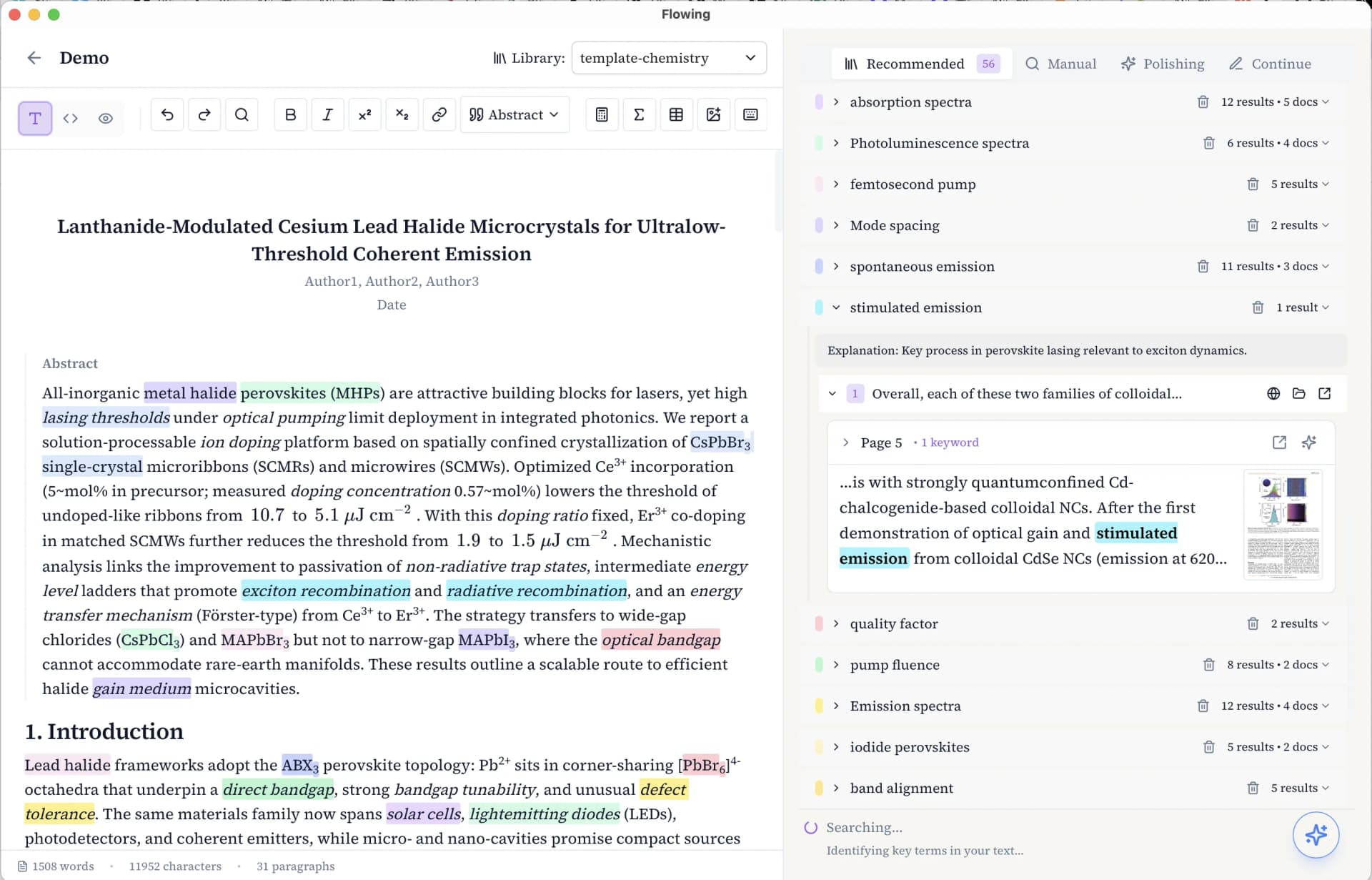
Those snippets stay available while you write. You can preview the original paragraph via its page thumbnail, or open the source PDF at that passage in one click.
It sounds like a small interaction. In practice, it fundamentally changes how AI writes.
Better evidence leads to better AI
This also changes AI writing itself. Most AI assistants generate text primarily from their internal knowledge. Flowing instead lets AI draft from those snippets—passages retrieved from your paper library, not from general knowledge alone.
When you continue a manuscript, the Snippet Cards don’t just sit beside the editor. They become the basis for the next sentences, so the continuation stays closer to your sources, terminology, and line of argument.
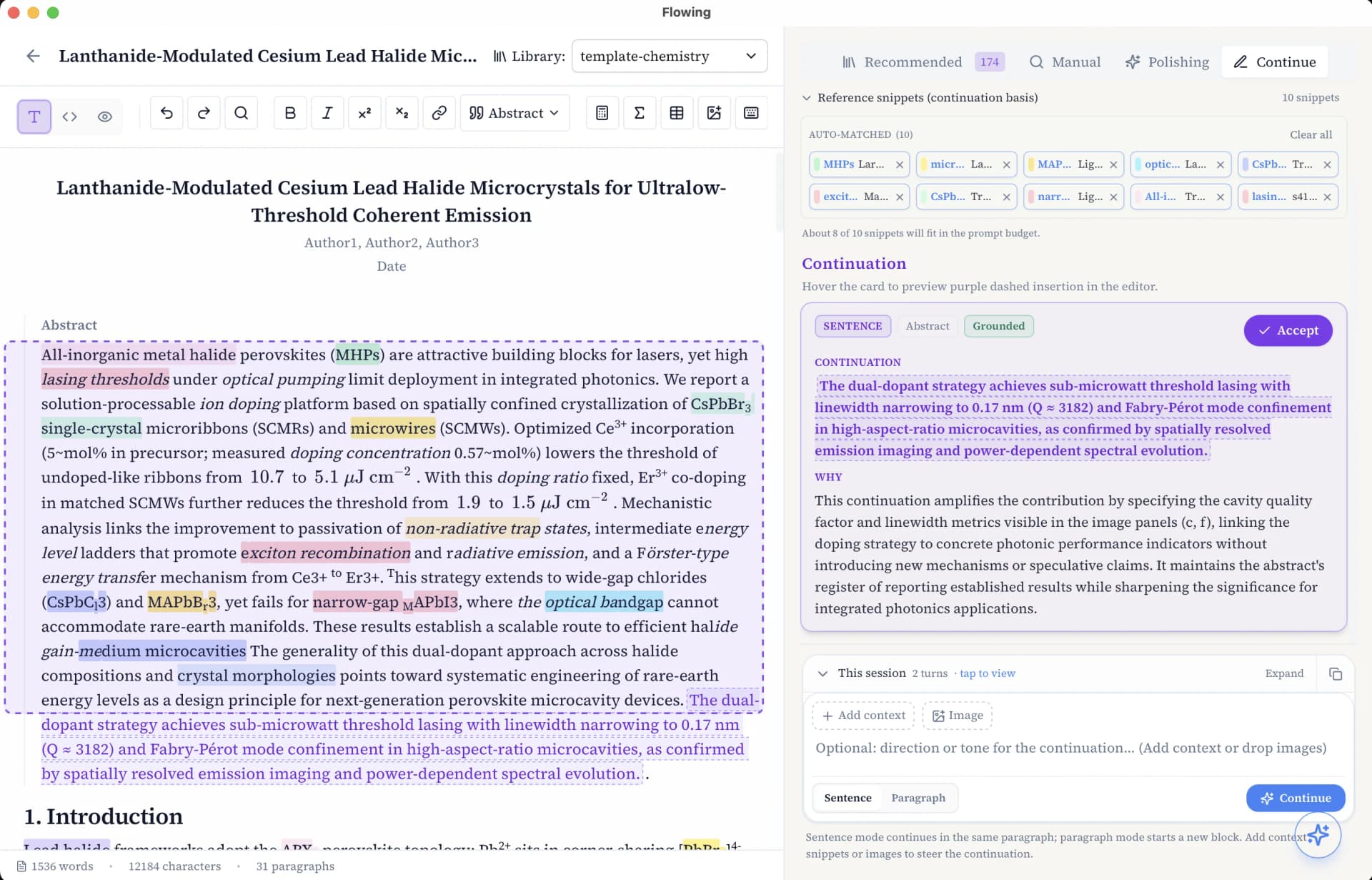
One of our earliest users—a chemistry professor—recently compared Flowing and ChatGPT while continuing a manuscript he was actively writing. Both systems used strong language models. The difference wasn’t the model. It was the context.
Because Flowing retrieved relevant passages from his paper library and used them as the basis for continuation, the generated text stayed much closer to his research direction, terminology, and upcoming discussion.
If you’re interested, you can read the complete comparison here → AI Continuation Comparison on a Real Chemistry Manuscript.
Where this leads
Large language models will keep improving. That’s inevitable.
For academic writing, the more important question is quieter: How do we make the right passages available at the moment of writing—for both you and the AI?
That’s where the next generation of academic writing may begin—and it’s the problem Flowing is built around: keeping your research library inside the writing loop—so you can recall the right passages as you write, while AI writes from that evidence.
If you’ve felt the same gap while drafting, we’d love for you to try Flowing.
Substack
Exploring the next generation of writing tools
Follow our Substack for essays on evidence-grounded AI writing, local research libraries, and where academic tools go next. Subscribe to join the conversation.
Join on Substack