
让你的写作
扎根于研究文献库

深度探索你的论文库,找到与当前写作相关的文献片段——并以此作为校验、润色和续写的有力依据。

让你的写作扎根于研究文献库

下一代学术写作工作流

索文 · 证据 · AI 写作

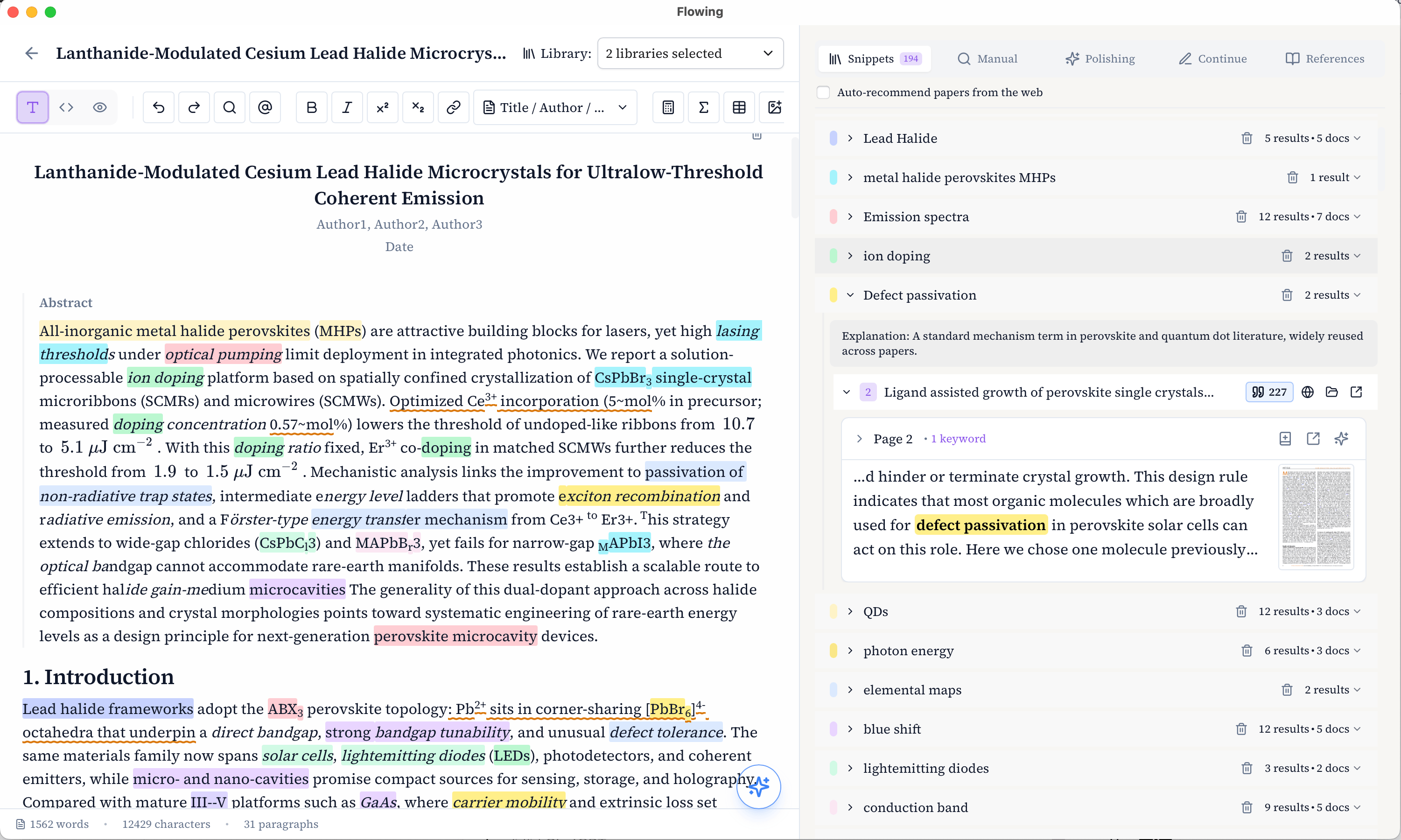
Flowing 主界面:左侧写作,右侧研究片段与引用

Flowing 与众不同之处

YOUR DRAFT

A passage worth keeping.

Selecting reaction conditions requires balancing conversion with the formation of the desired product. Published studies offer a starting point for identifying which experimental variables deserve closer examination.

Prior work suggests that influences the reaction pathway and ; catalyst loading may also shape selectivity.

↗ Select a highlighted phrase to recall related passages.
“temperature”2 passages · 2 papers

Comparisons between studies depend on the conditions behind each reported value. Catalyst loading, reaction time, and the temperature window must be considered before attributing a change in yield to a single factor.

The next experiments will vary temperature while keeping the remaining conditions fixed. Measuring both yield and product distribution will help distinguish improved conversion from a shift toward competing pathways.

RECALLED PASSAGES
PDF · p. 12
Temperature dependence

Increasing the temperature from 40 °C to 60 °C reduced the reaction yield from 68% to 42%, indicating less favorable product formation at the higher temperature.

PDF · p. 8
Tested temperature range

The effect was observed between 20 and 30 °C. Temperatures outside this range were not tested.

PDF · p. 24
Product selectivity

Product selectivity varied with reaction temperature. The highest isolated yield was obtained at 40 °C under the tested conditions.

PDF · p. 18
Yield optimization

Under otherwise identical conditions, optimized catalyst loading improved isolated product yield while preserving selectivity.

Snippet Card

01 / Snippet Card

想起那句话,直接回到原文

顺着当前思路找回相关段落,并一键回到完整原文。

YOUR DRAFT

Temperature and yield

Temperature is a key variable in the comparison of reaction conditions. The reported yields provide a basis for examining how thermal changes affect product formation within the experimental system.

At 60 °C, the reaction yield increased from 42% to 68%. This improvement suggests that higher temperature favors product formation.

Interpreting this comparison requires separating the reported result from its proposed explanation. Yield alone does not establish a mechanism; catalyst stability and competing reaction pathways also need to be considered.

Further experiments should examine these contributions individually, using matched reaction conditions to distinguish temperature effects from changes in catalyst activity or product selectivity.

EVIDENCE CHECK
× Contradicted

The numbers are reversed.

The source reports a decrease from 68% to 42% at 60 °C, not an increase. The draft reverses both the values and the direction of the effect.

RESEARCH ARTICLE · DEMOp. 12
3.2 Temperature-dependent yield

Increasing the temperature from 40 °C to 60 °C reduced the reaction yield from 68% to 42%, indicating less favorable product formation at the higher temperature.

Results are interpreted within the experimental conditions described here. The selected passage is highlighted for comparison with the manuscript.

Y = nproduct / ninitial × 100%(3)
68%42%4060T (°C)
Fig. 2 | Yield at two temperatures. Illustrative schematic.
Illustrative source excerpt · not a published paper

Evidence Card

02 / Evidence Card

这句话,证据撑得住吗?

Evidence Card 一眼看懂:红色表示冲突,绿色表示支持,黄色表示需要补充重要限定。

YOUR DRAFT

Keep the thought moving.

Temperature-dependent changes in reaction yield provide a useful starting point for selecting operating conditions. Applying these findings to a new system, however, requires attention to the range examined in the original experiments.

✦ WRITING WITH YOUR LIBRARY

Generating two sentences with linked source passages.

A follow-up study could extend the temperature series while holding catalyst loading and reaction time constant. Comparing yield and selectivity at each step would help establish whether the same trend persists.

LIBRARY EVIDENCE
Each passage links to its source · illustrative example

Autocomplete

03 / Autocomplete

带着证据,顺着思路写下去

下一句与依据同步出现;就地检查,再决定是否插入。

Ness Labs

Featured Tool

Ness Labs 精选工具

Flowing 入选 Tools for Thought

Ness Labs 是一个关注如何更好思考、学习与工作的知识平台。Flowing 现已入选其 Tools for Thought 系列,其中也包括 Notion、Obsidian 等生产力与知识工具。

前往 Ness Labs 阅读访谈

如何使用

从文库到成稿,七步完成

导入参考文献,用富文本与 LaTeX 撰写,带依据自动补全,顺词索文,带上下文提问,基于证据打磨,再续写——一切锚定你的本地论文库。

观看分步教程视频

科研工作流

融入你现有的科研工作流

Flowing 是写作环境。当前章节需要的 PDF 导入进来即可;规范文献库仍放在你已经在用的工具里。

PDF 与索引保存在本机 · 不上传完整文库 · AI 请求会发送所需手稿上下文与相关片段 查看数据流

  • PDF

    本机导入、检索、预览与导出。

  • LaTeX

    与富文本并排编辑 .tex,并提供实时 PDF 预览。

  • BibTeX

    解析文稿中已有的 BibTeX 与编号参考文献块。

  • Zotero

    两者一起用:规范文献库仍由 Zotero 管理。

  • 富文本

    应用内 Word 风格编辑;支持导入、导出 Word(.docx)与 PDF。

  • 引用

    用 @ 插入结构化文库引用,并配有 References 侧栏。

文献库继续用 Zotero;Overleaf 或 Word 也留在它们已经适合的位置。Flowing 专注写作阶段——在你落笔时,把论文、引用与草稿上下文收拢到一处。

Flowing 与 Zotero 的关系

目前不支持与 Overleaf 直接同步。

博客精选

Flowing 背后的想法

让 AI 辅助学术写作扎根于研究者自身的知识与文献,这一理念正受到越来越多研究者和学术专业人士的关注。加入 Substack,持续关注这场讨论。

开始写作

让参考文献真正成为打磨论文的利器。

找回一段原文,核对一个主张,接上下一句话。从你正在写的那段开始。